A faculty member at the Department of Mechanical Technologies, Basra Engineering Polytechnic College, Dr. Mohammed Hameed Radhi, has co-authored and published a scientific research paper
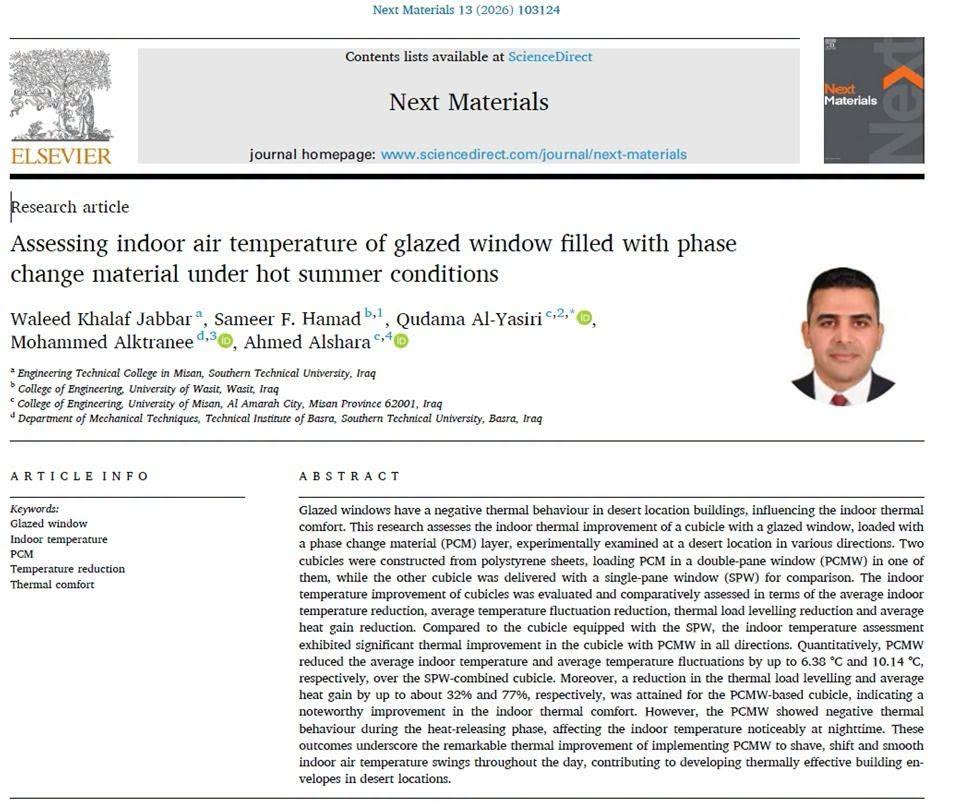
A faculty member at the Department of Mechanical Technologies, Basra Engineering Polytechnic College, Dr. Mohammed Hameed Radhi, has co-authored and published a scientific research paper entitled:
“Assessing Indoor Air Temperature of Glazed Window Filled with Phase Change Material under Hot Summer Conditions”
The research was published by the internationally renowned publisher Elsevier in the Journal of Next Materials, which has an impact factor of 7.4 and a CiteScore of 7.2.
The study aims to evaluate the indoor thermal performance of a test chamber equipped with a glazed window incorporating a layer of phase change material (PCM), through an experimental investigation conducted at a desert site from different perspectives. Two chambers constructed from polystyrene panels were used for the experiment. One chamber was equipped with a double-glazed window integrated with phase change material (PCMW), while the other was fitted with a single-pane window (SPW) for comparison.
The indoor thermal performance of the two chambers was assessed and compared based on the average reduction in indoor temperature, the average reduction in temperature fluctuations, the level of thermal-load stabilization, and the average heat gain.
Compared with the chamber equipped with a single-pane window, the chamber incorporating the PCMW system demonstrated significant thermal improvements across all evaluated parameters. Quantitatively, the PCMW system reduced the average indoor air temperature and temperature fluctuations by up to 6.38°C and 10.14°C, respectively, compared with the chamber equipped with the SPW system.
Furthermore, reductions of up to 32% in thermal-load stabilization and 77% in average heat gain were achieved in the chamber equipped with the PCMW system, indicating a substantial improvement in indoor thermal comfort. However, the PCMW system exhibited unfavorable thermal behavior during the heat-release phase, which had a noticeable effect on indoor temperature during nighttime.
The findings confirm the significant thermal benefits of incorporating the PCMW system in reducing, moderating, and stabilizing indoor air-temperature fluctuations throughout the day. These results contribute to the development of thermally efficient building envelopes suitable for hot and desert climates