Faculty Member at Basra Engineering Polytechnic College Publishes Joint Scientific Research
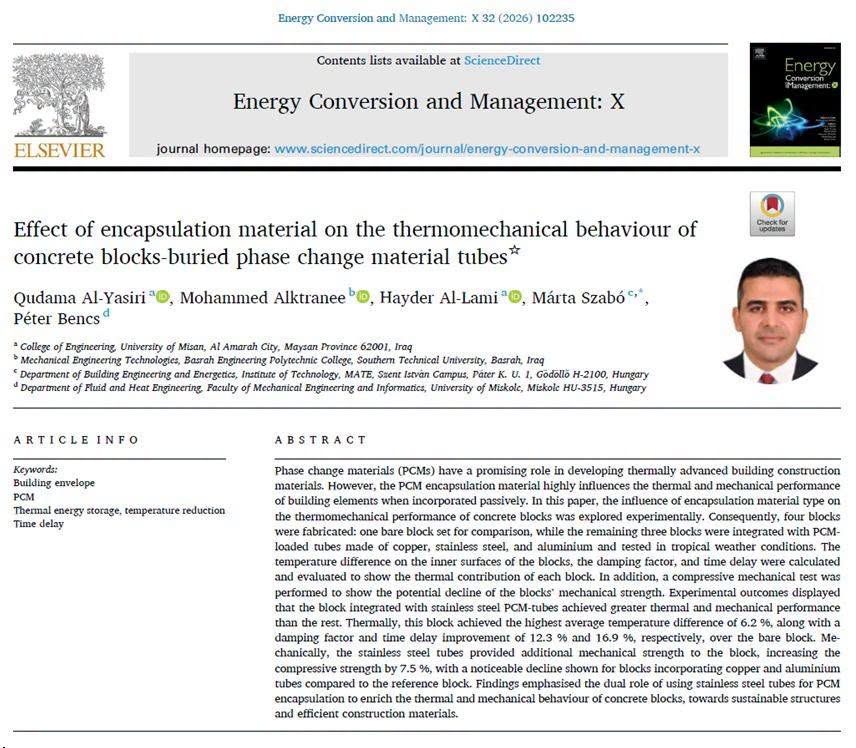
A faculty member at the Department of Mechanical Engineering Technologies, Basra Engineering Polytechnic College, Lecturer Dr. Mohammed Hameed Radhi, has co-authored and published a scientific research paper entitled:
“Effect of Encapsulation Material on the Thermomechanical Behaviour of Concrete Blocks-Buried Phase Change Material Tubes under Summer Conditions”
The research was published by the international publisher Elsevier in the journal Energy Conversion and Management: X, which has an impact factor of 8.8 and a CiteScore of 11.4.
Phase change materials (PCMs) are considered promising materials for the development of advanced thermally efficient building materials. However, the encapsulation material used for PCMs can significantly affect the thermal and mechanical performance of building elements when PCM systems are indirectly integrated into them.
In this study, the effect of encapsulation material type on the thermal and mechanical performance of concrete blocks was experimentally investigated. Four types of concrete blocks were fabricated: one unencapsulated reference block and three blocks incorporating PCM-filled tubes made of copper, stainless steel, and aluminum. The specimens were tested under tropical climatic conditions.
The temperature difference across the inner surfaces of the blocks, together with the damping factor and time lag, was calculated and evaluated to determine the thermal contribution of each configuration. In addition, mechanical compressive strength tests were conducted to assess the potential reduction in the mechanical strength of the concrete blocks resulting from the integration of the PCM tubes.
The experimental results demonstrated that the concrete block incorporating stainless-steel PCM-filled tubes achieved superior thermal and mechanical performance compared with the other configurations.
From a thermal perspective, this configuration achieved the highest average temperature difference of 6.2%, along with improvements of 12.3% in the damping factor and 16.9% in time lag, respectively, compared with the untreated reference model.
From a mechanical perspective, the stainless-steel tubes provided additional mechanical reinforcement to the concrete block, increasing its compressive strength by 7.5%. In contrast, the blocks incorporating copper and aluminum tubes exhibited a noticeable reduction in mechanical strength compared with the reference model.
The findings highlight the dual role of stainless-steel tubes as an effective encapsulation material for PCMs, enhancing both the thermal and mechanical properties of concrete-based building elements. The study contributes to the development of more sustainable structural systems and energy-efficient building materials.